
Vision
Clients
Mission
Illuminate the path to an inclusive and resilient low-carbon energy transition.
Utilities, governments, citizens groups, unions, foundations, business, advocacy organizations, ENGOs, elected officials, and Indigenous Nations and organizations.
To weave evidence with relevant perspectives to support decision-making in energy transitions. We offer research, interactive training, strategic and contextual insight, and knowledge translation, to help you understand the conditions that shape effective low-carbon action, policy, and program design.
Ready to accelerate your transition? Contact us.


Professional Research
Bridging Perspectives and Knowledge
Shaping Research
Lived Experience
Academic Training
Policy Advice
Experience
As a professional researcher I have led innovative empirical research programs for over 20 years. I have produced award winning and policy relevant research, using document analysis, surveys, interviews, workshops, and formal partnerships as methods to gather data and design research.
I have engaged in conversations with governments, diverse communities, utilities, foundations, business, academia, media and advocacy. I have come to understand a range of perspectives, baseline knowledge, and questions that people have about energy transitions.
By providing context, I help clients articulate the questions about low-carbon energy transitions they need answered. I gather information from relevant sources and interest holders, design qualitative analytical research methods matched to the project’s scope, and validate findings.
My expertise is grounded in lived experience, formal training, hands-on policy experience, and professional work with Indigenous, racialized, neurodivergent, newcomer, francophone, gender-diverse, and 2SLGBTQIA+ communities.
I hold a B.Eng in chemical engineering (McGill University) in which I developed expertise in systems thinking and the application of thermodynamic laws. I studied ecological economics (York University) focusing on the competing philosophies of strong and weak sustainability approaches to resource extraction, and wrote a systematic review of the evidence on natural gas and electricity price design impact on resource consumption and conservation. In my PhD in human and economic geography (University of Waterloo) I learned theories of diffusion of innovations and applied contextual analysis approaches to understand the impact of policy and program design on energy efficiency decisions.
As a policy advisor, I worked on the coal cessation regulation for the province of Ontario, the design, pause and review of the renewable energy standard offer program (RESOP) in Ontario, and on demand side management for for the Association of Major Power Consumers in Ontario (AMPCO) and for a utility.
Expertise
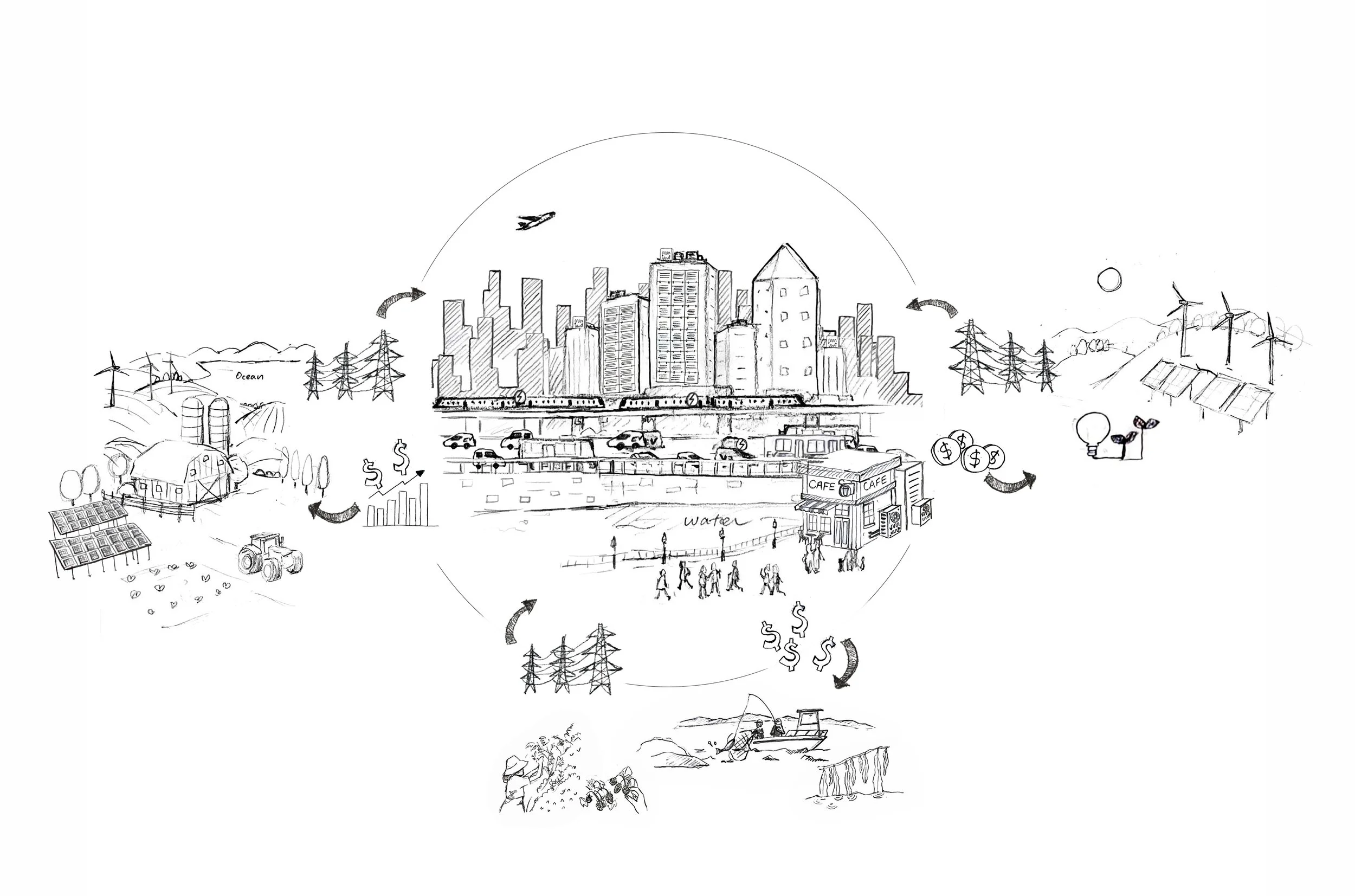
Circe Energy understands the conditions that shape whether and how energy technologies and infrastructures are implemented and accepted. We help clients understand how policy, governance, markets, institutions, social dynamics, workforce and place-based factors influence the uptake of low-carbon energy solutions—individually and in combination.
Innovations, technologies and infrastructures
Our work spans a wide range of technologies and infrastructures, including renewable electricity, grids and transmission, energy storage, nuclear, carbon capture, hydrogen, energy efficiency, and coal phase-out.
Policy for innovation implementation
We analyze how policy design, regulatory frameworks, incentives, market structures, interest holder involvement and governance affect the implementation and market share of low-carbon technologies. We help clients understand why most low-carbon innovations struggle to scale beyond niche markets—and what policy and market conditions support increased uptake across regions and sectors.
Impacts and Interests
Workforce transition
Social acceptance of low-carbon innovations depends on perceptions of fairness in governance processes and anticipated and felt impacts. The implementation of new energy technologies and infrastructures can affect regional economies and priorities differently as they are felt differently in urban centres of energy demand and rural communities.
Limited diversity, and its documentation, in the energy workforce presents challenges for energy transitions.
Services
Interactive training and coaching
The energy and climate sector is defined by complex problems and the need to consider a range of information and a variety of perspectives. We offer tailored and interactive training services such as workshops, and personalized coaching designed to help clients work through issues, publicly or privately, to develop their own understandings and actions. Our approach aims to provide better understanding across experiences, disciplines, and worldviews—supporting more informed dialogue, clearer priorities, and confident action.
Information baselines and qualitative methods
Policy relevant analysis
Knowledge translation and mobilization
Oftentimes, the information needed for decision-making is not measured or accessible, and sometimes contradicting, leading to blind spots and paralysis in energy and climate strategies. We help clients identify which information is accessible, how to gather additional information from relevant sources and interest holders using a range of qualitative methods, and how to validate the information gathered. We use curated workshops, qualitative interviews, surveys, written feedback, and document analysis.
We help clients work shape the analysis that they need to design policies, programs and actions in low-carbon energy transitions. This includes analysis of how policy and regulatory frameworks, governance process, anticipated and felt impacts, workforce diversity and transition, place-based and regional dynamics can shape outcomes.
Explore the role of governance and institutions shaping outcomes
Our services include preparation of reports, opinion pieces, briefings, presentations, publications, media engagement, and expert testimony.